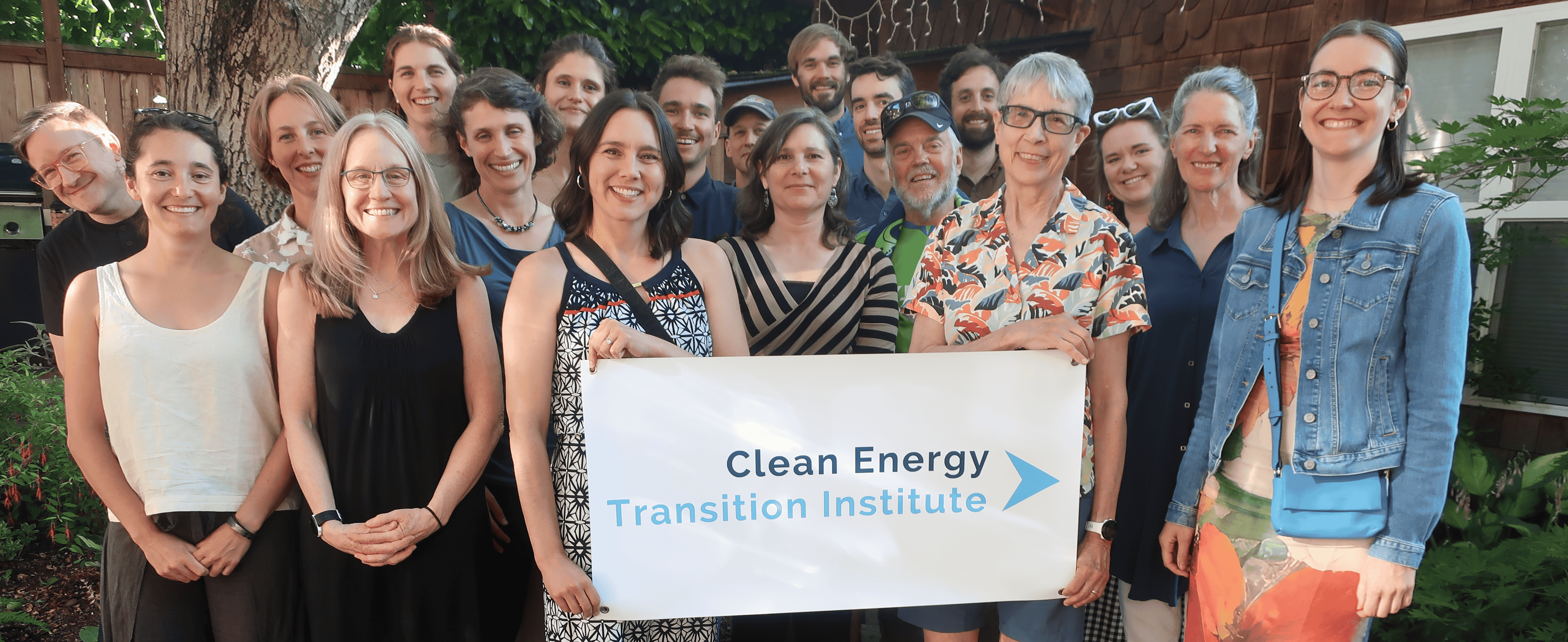
April is when the Clean Energy Transition Institute (CETI) takes care of business.
First up, the Board of Directors held its Annual Meeting on April 9 and elected Crystal Ball Secretary of the CETI Board. Crystal takes over the post from Ross Macfarlane, who deserves an enormous amount of gratitude for holding this position from CETI’s inception eight years ago until today.
The Board Secretary is responsible for keeping nonprofit organizations legally compliant and the job entails a LOT of work, especially when you start an organization, but also each year to ensure your Bylaws are current and your Board is properly governed. Ross never flagged in his enthusiasm for this sometimes-tedious work, and I am deeply grateful to him for how he has had our back year in and year out since 2018. Thank you to Crystal for stepping into this role!
April also brings the completion of our 990, the tax form that nonprofits must file each year to let the world know how much money they received and what they did with those funds. CETI’s 990s are posted on the website for the world to see, so if you are interested in reading our 2025 990 (or any that we filed in the past), please head over here and scroll past our donor honor roll to find all our 990s.
This month we wrote our Impact Report, which is with our designer now. We will send it out in a separate mailing as soon as it is ready. We hope that you will take time to review it to be reminded of all that we worked on during 2025. CETI could not do what we do without your support and engagement, so thank you very much. If you are so inclined, let us know how you think we did last year.
The application window for CETI’s next Executive Director closed on April 24. We are so grateful to all who shared the job announcement with their networks. The Search Committee, led by Clover Search Works, has begun reviewing applications and screening applicants in advance of scheduling interviews.
Saving the best for last: CETI Research Analyst Ruby Moore-Bloom gave birth to a beautiful baby girl, June Florence Tennis, in the wee hours of the morning on March 3, 2026. We are thrilled that all went so well with the birth and continues to be so for Ruby and her family.
Sincerely,
Eileen V. Quigley
Executive Director
Program Updates
SCALE 2030
The SCALE 2030 Team is gearing up to launch the SCALE 2030: Clean Buildings Roadmap for Washington. This project builds off two papers we released last May – SCALE 2030: Clean Buildings Ecosystem Assessment for Washington and SCALE 2030: Clean Buildings Transition Framework for Washington.
The Roadmap proposes 16 actions that would advance Washington’s approach to building decarbonization between now and 2030 to build a foundation for rapid, large-scale implementation. It will live on a new website that is in beta-testing now and will feature past and future SCALE 2030 work.
We invite you to join us for a webinar on June 2 from 2-3pm PST, during which CETI Research Analyst Jeanne Currie and Poppy Storm (2050 Institute) will walk through the levers and actions that the Roadmap identifies as critical to achieving building decarbonization in Washington. Register here.
In addition to the webinar, Jeanne and Poppy will be hosting a Lunch Roundtable discussion at NEEA’s Efficiency Exchange conference about the Roadmap. Jeanne will also do a lightning talk highlighting the Roadmap at the 2030 District’s upcoming Energy Insights Showcase, Expo & Happy Hour.
Featured Work: Washington's Final Comprehensive Climate Action Plan
The Washington State final Comprehensive Climate Action Plan (CCAP) was released on April 22, timed for Earth Day, at a roundtable in Pierce County led by Department of Ecology Director Casey Sixkiller, Department of Commerce Assistant Director Jennifer Grove, and Pierce County Executive Ryan Mello. Commerce held a public meeting on April 27 to brief Washingtonians on the CCAP’s key findings and initiatives.
In Case You Missed It
- On April 27, 2026, the Pacific Northwest Utilities Conference Committee (PNUCC) released its 2026 Northwest Regional Forecast, which shows that load growth is outpacing regional utilities’ traditional planning and development processes and timelines. Utilities are scrambling to add cleaner generation and scaling demand-side solutions to meet accelerating electricity demand and reduce the risk of blackouts, but they cannot do so fast enough to close the projected gap in demand.
- The Forecast concludes with several near-term priorities for collaboration, including continuing investment in energy efficiency and demand response along with exploring the flexibility potential of data center and other large loads; advancing transmission development for reliability; strengthening emergency preparedness; developing emerging technologies; advancing policy alignment and regulatory support; and evaluating and refining regional approaches to resource adequacy.
- Also this month, the Lawrence Berkeley National Laboratory (LBNL) published Retail Electricity Price Trends and Drivers. Surprisingly, adjusted for inflation, national-average electricity prices generally held constant and are slightly below what they were 20 years ago, although changes vary widely by sector and by state. National-average residential prices increased 5.6% between 2019 and 2025. In the Northwest, adjusted for inflation, Washington and Oregon saw average retail electricity prices increase between 2019 and 2025 while Montana and Idaho did not.
- Related to the LBNL report, Heatmap News and MIT released the Electricity Price Hub in partnership with CleanEcon, an interactive map of the United States where you can compare average electricity bills by state, utility, congressional district, county, or zip code.
- Pacific Northwest utilities and independent power producers commissioned Energy+Environmental Economics (E3) to evaluate the state of current and future resource adequacy in the region. The result is Resource Adequacy and the Energy Transition in the Pacific Northwest. Key study questions address near- and long-term resource adequacy needs; barriers to meeting those needs; the role of new natural gas peaking capacity; and the constraints of Northwest load.
Worth a Listen or a Read
- A well-written and well-reported blog by Renewable Energy Farmers of America, What Arizona is Doing About Community Engagement in Renewable Energy, is a must-read for all of us who are working hard to build the clean energy economy in partnership with rural communities instead of in opposition to them. Many thanks to Jim Thornton, the Environmental Permit Coordinator in the Washington Governor’s Office of Regulatory Innovation and Assistance, who alerted us to this piece.
- Ezra Klein’s conversation with Jason Bordoff, founding director of Columbia University’s Center on Global Energy Policy, What Happens if 20 Percent of the World’s Oil Disappears?, was fascinating and important to listen to for context as the energy crisis caused by the war in the Middle East continues.
- The always excellent Gernot Wagner published a piece in Nature on April 16, Why more fossil fuels won’t fix the Iran energy crisis. He asserts that “climate-friendly technologies are the best way to stymie rising inflation—and will get better and cheaper over time.” He illustrates his points with his usual solid data analysis. In a similar vein, David Wallace-Wells of The New York Times column describes how the war is accelerating the shift to clean energy around the world in The Only Good News From Iran.
- Latitude Media’s Open Circuit featured a lively and informative discussion with Cloverleaf’s Brian Janous (who spoke at CETI’s Data Center Decarbonization Forum in April 2025) and Caroline Golin, formerly at Google who is now NRG’s Chief Growth and Policy Officer, called Grid utilization vs expansion: The 100 GW debate. These two old hands at data center development unpacked the questions surrounding grid utilization and grid expansion.
- Nuclear power is having a moment and so it was very helpful to listen to Catalyst’s Shayle Kann talk through issues of nuclear waste creation and disposal in The state and future of nuclear waste with Dr. Jen Shafer, a former ARPA-E Director and current professor at the Colorado School of Mines, and discuss supply chain challenges in Building a domestic nuclear fuel supply chain with Scott Nolan, founding CEO of General Matter.
- The excellent nonprofit Resources for the Future, along with Columbia University’s Center of Global Energy Policy, the University of Notre Dame, and Montana State University, are holding a four-part webinar series called Building More Resilient Energy Economics, where they will share results from sponsored research projects designed to inform policymaking and economic development strategies in fossil-dependent regions.
- What Americans Really Pay for Electricity accompanied the release of Heatmap and MIT’s Electricity Price Hub (see ‘In Case You Missed It’ above) and is an excellent piece. How Electricity Prices Fuel Data Center Opposition is also worth a read.
- In an Idaho State Journal opinion piece, Bannock County Commissioner Jeff Hough considers the economic loss of a county ban on solar and wind projects and proposes moving towards an ordinance that would allow careful consideration of proposed projects and their benefits.
Stay Tuned. . .
Jeanne and Eileen are headed to Boise, Idaho in May for two conferences. If you will be at either of these events, make sure to say ‘hi!’:
- Northwest Energy Efficiency Alliance (NEEA)’s Efficiency Exchange (EFX) Conference
- May 4 – May 5
- Learn more and register here.
- Northwest Energy Coalition (NWEC)’s Northwest Transmission Summit
- May 7 – May 8
- Learn more and register here.
If you want to receive updates from CETI straight to your inbox, subscribe here.


.jpeg)

.jpeg)