Reimar

Expanding Transmission Without Building New Lines

With electricity demand rising due to electrification of transportation, buildings, and industry, as well as data centers, Northwest energy planners are working overtime to ensure the electricity grid remains stable and resources are adequate to meet ever-increasing demand.

While energy planners may disagree about the best resources to develop to meet demand, there is uniform acceptance that the Northwest, and the United States for that matter, needed more transmission yesterday.

But investment in new high-voltage lines peaked in 2013 and has steadily fallen over the last 10 years, as this figure from Grid Strategies July 2024 report, Fewer New Miles: The US Transmission Grid in the 2020s, shows:
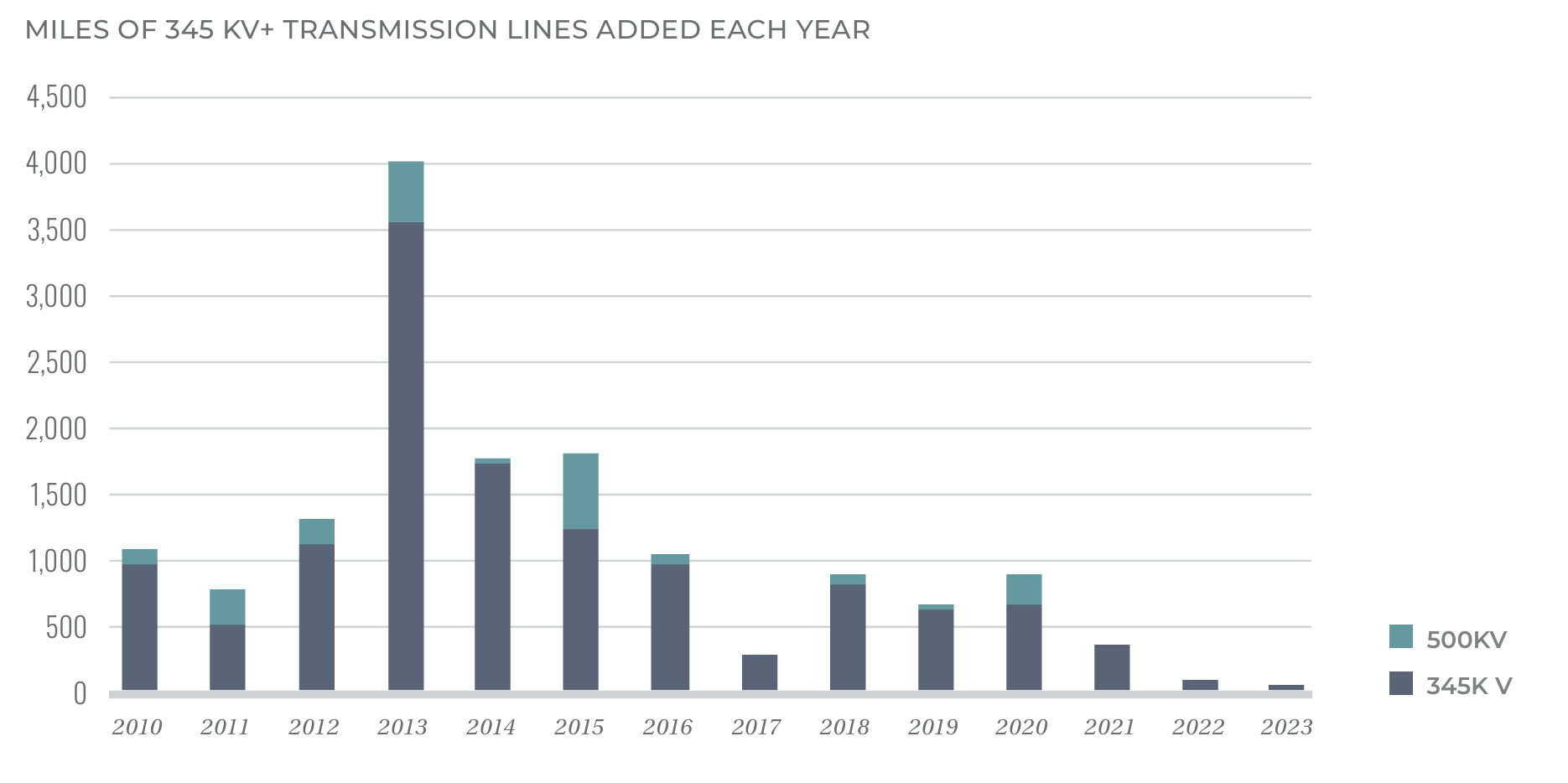
Figure 1, from Grid Strategies report Fewer New Miles: The US Transmission Grid in the 2020s, shows that investment in high voltage transmission lines peaked in 2013.

Advanced transmission technologies (ATTs)

Advanced transmission technologies (ATTs) offer solutions that could be deployed today at significantly less cost to expand the capacity of existing transmission lines. So, what are ATTs and how can they help meet electricity demand quickly and less expensively than building new transmission lines?

ATTs are a set of infrastructure, hardware, and software options that increase the capacity and resilience of transmission lines’ to carry more electricity, improve reliability, and reduce system congestion. There are three broad categories of ATTs as follows:

  1. Grid Enhancing Technologies (GETs) are a combination of software and hardware that make it possible to assess the real-time conditions of the electricity system and to optimize the existing grid. Examples of GETs include:

    • Dynamic Line Ratings (DLR): Use real-time weather data to determine how much power a line can actually carry, rather than relying on fixed conservative assumptions.
    • Advanced Power Flow Control: Redirects power from overloaded lines to underutilized ones.
    • Topology Optimization: Uses algorithms to analyze grid conditions and find optimal paths for power flow.
  2. Advanced/High-Performance Conductors (HPCs) are modern electric power lines made from advanced carbon-fiber and superconducting materials that are stronger, lighter, and have greater capacity than conventional transmission lines. These advanced materials enhance the amount of power flowing through transmission lines and are physical wire replacements that reconductor (or update/upgrade) existing lines.
  3. “Other ATTs” is a catch-all category for an evolving set of transmission technologies that are not software, hardware (GETs), or advanced transmission lines (HPCs), but provide capacity and reliability, such as transmission switching or storage-as-transmission, and other emerging technologies.

Cheaper and faster

Both GETs and HPCs are ATTs that expand transmission capacity without building new lines. The core difference between GETs and HPCs, which are the main non-GET ATT, is that GETs are software or operational tools that work by optimizing the operation of existing lines to better manage existing wires to transmit power at higher capacity and greater efficiency than is currently the case, while HPCs work by physically upgrading the wire itself to carry more power.

Both approaches are cheaper and faster than building new transmission lines, which is why they are grouped together under the ATT umbrella, but they are mechanically quite different technologies.

Other ATTs include transmission switching, which involves opening and closing devices (usually circuit breakers) to reconfigure an electrical network in such a way as to optimize the power flow. Electricity distributes across all available routes according to its electrical impedance. If transmission switching opens a new transmission line, power can be redirected from an overloaded part of the system to an underutilized segment.

Transmission switching has become viable in recent years due to advances in computation and software, which can now solve optimization problems fast enough to be operationally useful. Transmission switching is linked to the GET Topology Optimization, which is the broader software-driven process of finding the right switching actions; transmission switching is the physical execution of those actions.

Storage-as-transmission, or energy storage systems of any kind, are another type of ATT that can defer transmission expansion, help manage peak load, or enhance system resilience and reliability. Batteries can time shift power flows by storing power on either side of a transmission line to deliver when needed.

Other ATTs are an evolving category with emerging technologies including underground/subsea High Voltage Direct Current (HVDC) cables instead of overhead lines, as well as Virtual Transmission Lines, which are software-defined power flow rerouting across networks.

We need it all

ATTs will not solve all our transmission needs, so we still have to build lines that various studies such as the September 2024 Connected West study, WestTEC’s February 2026 West-Wide Transmission Study: 10-Year Horizon Report, and the Montana Regional Transmission Connectivity Study recommend. But investing in ATTs could help right now to provide new capacity and resilience while the region works to build new transmission.


If you want to receive updates from CETI straight to your inbox, subscribe here.

Open in new

Eileen V. Quigley

Founding Executive Director
Eileen V. Quigley is the Founding Executive Director of the Clean Energy Transition Institute (CETI), which works to accelerate an equitable clean energy transition in the Northwest, and has led CETI’s programs since 2018. Eileen has researched and written extensively about a wide range of decarbonization solutions since 2009, publishing numerous papers, reports, and blogs, and she speaks regularly about decarbonization solutions throughout the Northwest. Prior to founding CETI, Eileen spent seven years as Director of Strategic Innovation at Climate Solutions, where she oversaw programs that identified transition pathways off fossil fuels to a low-carbon future in Washington, Idaho, Oregon, and Montana and advanced clean energy solutions in cities and rural areas, aviation, carbon sequestration, and the electricity grid.
FULL BIO & OTHER POSTS

Expanding Transmission Without Building New Lines

With electricity demand rising due to electrification of transportation, buildings, and industry, as well as data centers, Northwest energy planners are working overtime to ensure the electricity grid remains stable and resources are adequate to meet ever-increasing demand.

While energy planners may disagree about the best resources to develop to meet demand, there is uniform acceptance that the Northwest, and the United States for that matter, needed more transmission yesterday.

But investment in new high-voltage lines peaked in 2013 and has steadily fallen over the last 10 years, as this figure from Grid Strategies July 2024 report, Fewer New Miles: The US Transmission Grid in the 2020s, shows:

Figure 1, from Grid Strategies report Fewer New Miles: The US Transmission Grid in the 2020s, shows that investment in high voltage transmission lines peaked in 2013.

Advanced transmission technologies (ATTs)

Advanced transmission technologies (ATTs) offer solutions that could be deployed today at significantly less cost to expand the capacity of existing transmission lines. So, what are ATTs and how can they help meet electricity demand quickly and less expensively than building new transmission lines?

ATTs are a set of infrastructure, hardware, and software options that increase the capacity and resilience of transmission lines’ to carry more electricity, improve reliability, and reduce system congestion. There are three broad categories of ATTs as follows:

  1. Grid Enhancing Technologies (GETs) are a combination of software and hardware that make it possible to assess the real-time conditions of the electricity system and to optimize the existing grid. Examples of GETs include:

    • Dynamic Line Ratings (DLR): Use real-time weather data to determine how much power a line can actually carry, rather than relying on fixed conservative assumptions.
    • Advanced Power Flow Control: Redirects power from overloaded lines to underutilized ones.
    • Topology Optimization: Uses algorithms to analyze grid conditions and find optimal paths for power flow.
  2. Advanced/High-Performance Conductors (HPCs) are modern electric power lines made from advanced carbon-fiber and superconducting materials that are stronger, lighter, and have greater capacity than conventional transmission lines. These advanced materials enhance the amount of power flowing through transmission lines and are physical wire replacements that reconductor (or update/upgrade) existing lines.
  3. “Other ATTs” is a catch-all category for an evolving set of transmission technologies that are not software, hardware (GETs), or advanced transmission lines (HPCs), but provide capacity and reliability, such as transmission switching or storage-as-transmission, and other emerging technologies.

Cheaper and faster

Both GETs and HPCs are ATTs that expand transmission capacity without building new lines. The core difference between GETs and HPCs, which are the main non-GET ATT, is that GETs are software or operational tools that work by optimizing the operation of existing lines to better manage existing wires to transmit power at higher capacity and greater efficiency than is currently the case, while HPCs work by physically upgrading the wire itself to carry more power.

Both approaches are cheaper and faster than building new transmission lines, which is why they are grouped together under the ATT umbrella, but they are mechanically quite different technologies.

Other ATTs include transmission switching, which involves opening and closing devices (usually circuit breakers) to reconfigure an electrical network in such a way as to optimize the power flow. Electricity distributes across all available routes according to its electrical impedance. If transmission switching opens a new transmission line, power can be redirected from an overloaded part of the system to an underutilized segment.

Transmission switching has become viable in recent years due to advances in computation and software, which can now solve optimization problems fast enough to be operationally useful. Transmission switching is linked to the GET Topology Optimization, which is the broader software-driven process of finding the right switching actions; transmission switching is the physical execution of those actions.

Storage-as-transmission, or energy storage systems of any kind, are another type of ATT that can defer transmission expansion, help manage peak load, or enhance system resilience and reliability. Batteries can time shift power flows by storing power on either side of a transmission line to deliver when needed.

Other ATTs are an evolving category with emerging technologies including underground/subsea High Voltage Direct Current (HVDC) cables instead of overhead lines, as well as Virtual Transmission Lines, which are software-defined power flow rerouting across networks.

We need it all

ATTs will not solve all our transmission needs, so we still have to build lines that various studies such as the September 2024 Connected West study, WestTEC’s February 2026 West-Wide Transmission Study: 10-Year Horizon Report, and the Montana Regional Transmission Connectivity Study recommend. But investing in ATTs could help right now to provide new capacity and resilience while the region works to build new transmission.


If you want to receive updates from CETI straight to your inbox, subscribe here.

Eileen V. Quigley

Founding Executive Director
Eileen V. Quigley is the Founding Executive Director of the Clean Energy Transition Institute (CETI), which works to accelerate an equitable clean energy transition in the Northwest, and has led CETI’s programs since 2018. Eileen has researched and written extensively about a wide range of decarbonization solutions since 2009, publishing numerous papers, reports, and blogs, and she speaks regularly about decarbonization solutions throughout the Northwest. Prior to founding CETI, Eileen spent seven years as Director of Strategic Innovation at Climate Solutions, where she oversaw programs that identified transition pathways off fossil fuels to a low-carbon future in Washington, Idaho, Oregon, and Montana and advanced clean energy solutions in cities and rural areas, aviation, carbon sequestration, and the electricity grid.
Full Bio & Other Posts

Get the latest updates from CETI directly to your inbox.

Related Posts