The Northwest expects to experience substantial growth in electricity demand in the immediate future and for decades to come. The latest forecast from the Northwest Power and Conservation Council, released in 2025, projects annual electricity demand growth in the range of 1.8% to 3.1% from 2027 to 2046 with an average annual growth rate of approximately 2.6%. Rising demand is fueled by a variety of sources, including data centers, industrial uses, as well as transportation and building electrification.
Pressure to meet current and forecast electricity demand has shone a light on the region’s insufficient grid infrastructure and the serious backlog of new energy resources that cannot connect to the grid. Regional power transfers are increasingly needed to move electricity to load centers far away from generation, which requires new interregional and interstate infrastructure. To complicate matters further, increased extreme weather events are taxing an aging grid, taking down lines just when the region is scrambling to build or refurbish more lines.
Grid planners and utilities have increasingly sounded the alarm on resource adequacy, reliability, and transmission issues over the past five years. One response to the call to do something is the Western Transmission Expansion Coalition (WestTEC), a West-wide effort to develop an actionable transmission study.
Work on WestTEC began in 2024, with the goal of establishing a new approach to transmission planning in the Western United States that would be “different, inclusive, expedient, and transparent.” WestTEC is a voluntary coalition of over 70 regional partners, including utilities and transmission developers, states, tribes, and public interest organizations.
The coalition, organized by Western Power Pool, hired the consulting firm Energy Strategies to produce two studies that “identify transmission solutions that reflect broad regional consensus, balance diverse interests, and create a repeatable framework for future planning”. The first study, West-wide Transmission Study 10-Year Horizon Report, was released on February 4, 2026. This report focuses on transmission needs required between now and 2035. The second study, which will look at transmission needs and solutions over the next 20 years, is expected in late 2026.
Throughout the process, CETI has participated as a member of the Regional Engagement Committee (REC), which is WestTEC’s primary stakeholder engagement group. Eileen V. Quigley serves on the REC, which was co-chaired by CETI Board member Robb Davis until January 2026. CETI Board member Crystal Ball serves on the WestTEC Steering Committee. The REC is responsible for reviewing proposals and scopes of work for technical studies and other deliverables. It also provides feedback and recommendations to the WestTEC Steering Committee.
REC meetings are open to the public and provide an opportunity for comment at the end. The other public interest organizations included in WestTEC are the Northwest Energy Coalition, Western Resource Advocates, and the National Resources Defense Council.
The study process started by developing a West-wide forecast of load growth and resource deployment. The consultant team used utility integrated resource plans (IRPs) to create these forecasts and place the forecasted resources at expected locations across the Western Interconnection.
Based on the location of these resources and load growth, Energy Strategies then created a “hypothesis map” of likely transmission needs where the existing transmission system would not be sufficient in 10 years. The hypothesis map included projects under development that could reasonably be completed by 2035.
In a series of modeling assessments, the hypothesis map was tested for its ability to maintain reliability, share resources across regions of the West, and avoid economic congestion on the grid. Transmission upgrades and new lines were added to solve for issues identified in the assessments.
The transmission portfolio included in the 10-year report identifies the need for 12,600 miles of new high voltage transmission lines or upgrades. Of those miles, 9,400 are already planned or in development. The remaining 3,300 miles1 represent additional upgrades or new lines that are needed to ensure a reliable and efficient grid in 2035. A quarter of the lines identified by WestTEC analyses are upgrades within existing transmission corridors. The rest are new development. The cost of the planned projects is approximately $47 billion, while the newly identified projects are estimated to cost $14 billion.
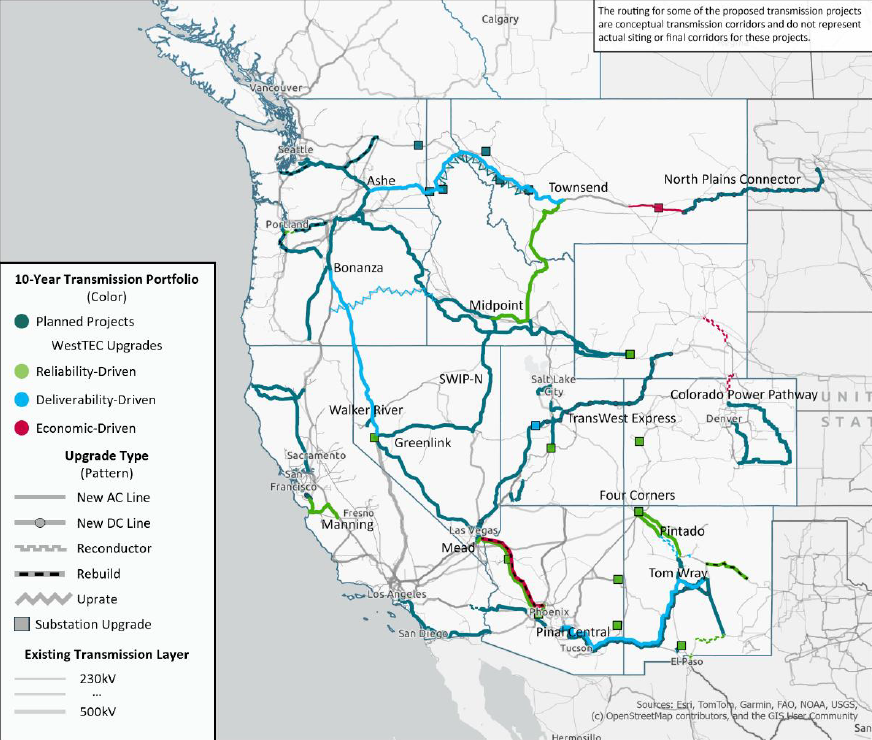
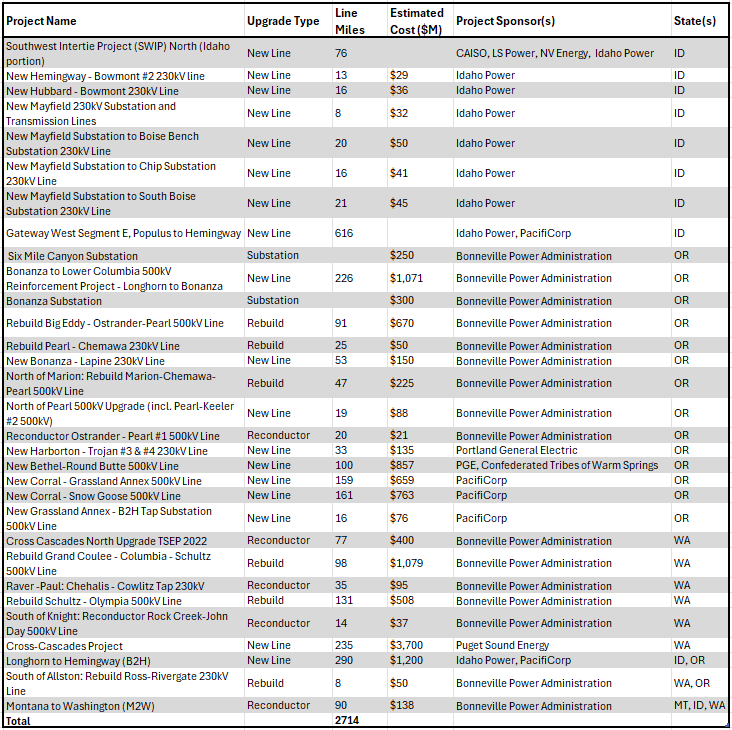
The following table shows lines from the 10-year portfolio that are in the Northwest four-state region and already planned by a project sponsor:
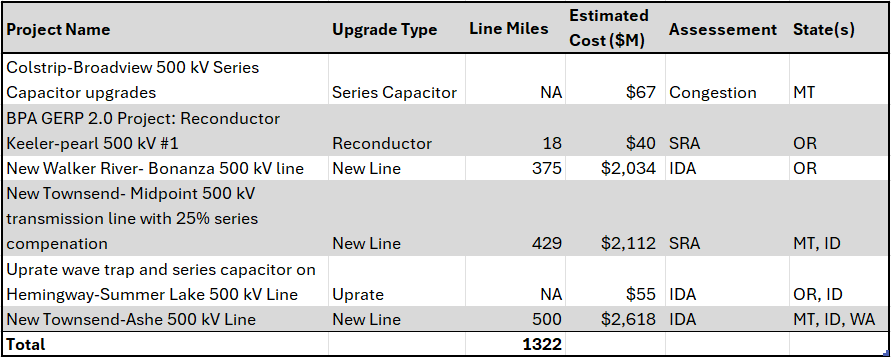
In addition to the already planned lines that need to be completed, the WestTEC assessments identify the following transmission needs by 2035 in the Northwest:
The report makes four recommendations to successfully implement the projects included in the 10-year transmission portfolio:
In the Northwest, much of transmission project completion depends on the Bonneville Power Administration, which operates 75% of high-voltage transmission in the region. BPA is the sponsor for ~35% of the planned lines included in the 10-year portfolio. For newly identified lines, collaboration will be needed between BPA, utilities, and developers to determine project sponsorship.
WestTEC’s next step is to complete a 20-year study, which will include two scenarios in addition to a Reference Case and will dive deeper into the benefits of transmission development. The two scenarios represent highly different futures, which will help identify “least regret” transmission projects that are likely to be valuable across a range of future load growth possibilities and technology developments.
CETI will remain involved on the REC, providing feedback on methodology and results as they emerge. We also plan to host a Decarbonization Forum in summer of 2026 exploring the case for transmission upgrades in Washington and how to pursue those upgrades.
There is no doubt that new transmission capacity is a critical piece of ensuring that the West’s electricity grid can handle load growth and increasingly extreme weather in the most efficient and affordable way possible. As fundamental infrastructure, transmission expansion is instrumental to future economic security across the Northwest and paramount to a successful clean energy transition. With the WestTEC 10-Year Report, the region holds an initial roadmap to its energy future.
1. Total does not add to 12,600 miles due to rounding
If you want to receive updates from CETI straight to your inbox, subscribe here.


.jpeg)



%20(1).jpeg)