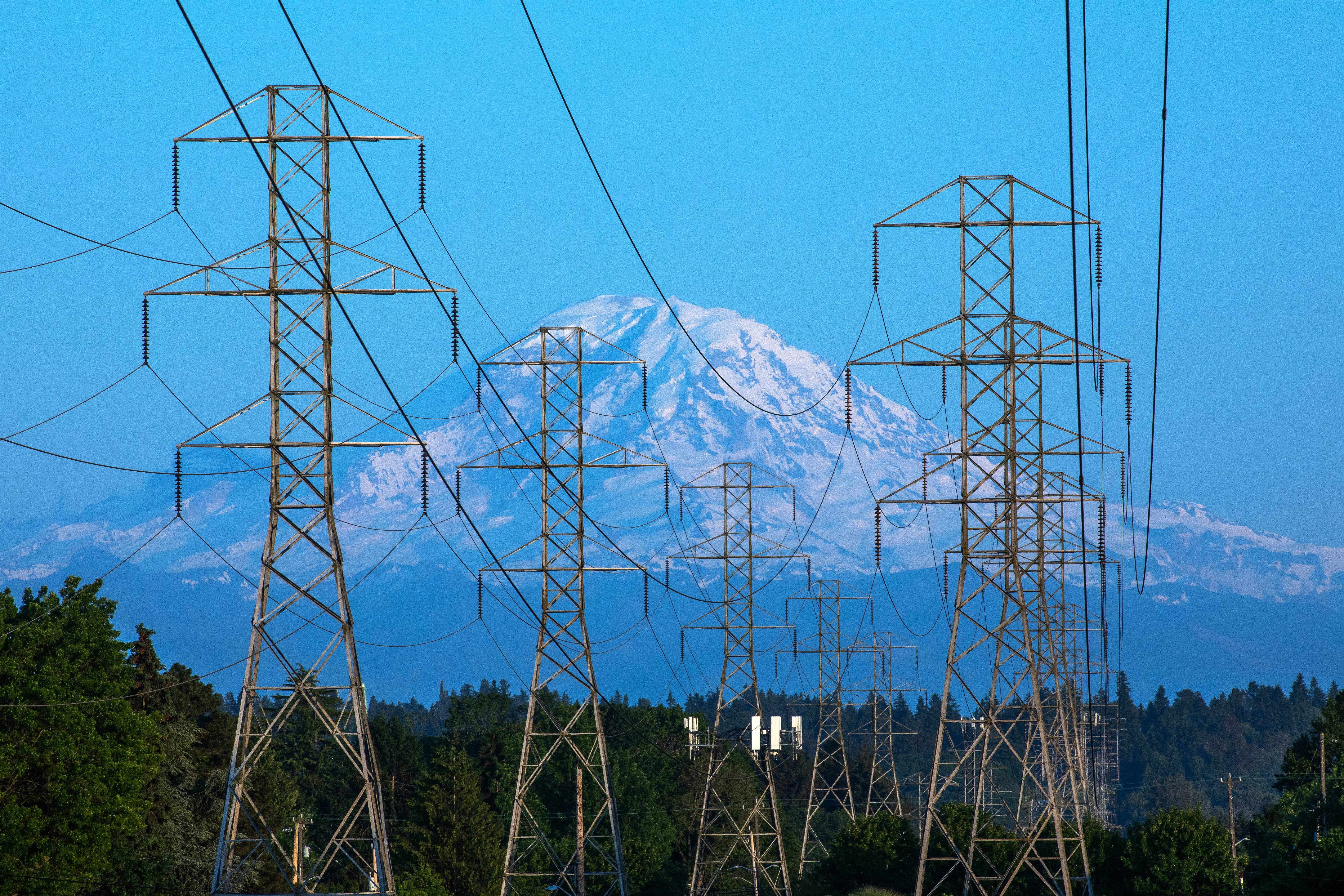
CETI recently completed a transmission assessment brief focused on Washington state with funding from the Stolte Family Foundation. The brief compiles existing information about Washington’s transmission landscape into one resource. This blog extracts key takeaways from the brief that highlight transmission priorities for Washington, barriers to development, emerging solutions, and progress underway.
As demand for electricity grows, we need more transmission to move power from where it is generated to where it is used. Washington’s grid is also evolving as the state shifts from fossil fuels to wind, solar, and potentially next generation geothermal or nuclear as these emerging technologies become viable. Regardless of the source, the region’s transmission system requires significant improvement.
Several recent state and regional efforts have examined what additional transmission capacity is needed, and where. These efforts have identified two major transmission routes in Washington with the most need for additional capacity: Montana to Washington and an east/west connection across the Cascades. These corridors, or routes that host one or more transmission lines, appear in several studies including the Western Transmission Expansion Coalition’s 10-year report and Connected West. Washington’s Comprehensive Climate Action Plan (CCAP) also modeled transmission needs between Washington and other states and found Montana-Washington to have the highest need, up to 82% increased capacity by 2050, largely to facilitate imports of high-quality wind-generation electricity from Montana to Washington.
Even with a shared sense of priorities, unknowns remain. Modeling for the state’s CCAP found that the 2025 federal rollback of tax credits for wind, solar, and green hydrogen shifts Washington’s least-cost clean energy pathway towards geothermal development. With fewer renewable energy imports and more in-state geothermal, Washington’s need for transmission expansion would be reduced. However, future changes in federal policy or challenges with geothermal development could shift the balance back towards wind, solar, and increased transmission expansion needs. This uncertainty supports an “all of the above” approach for Washington: advancing geothermal and other in-state resources to the extent possible, while still developing transmission projects to import out-of-state resources.
To be built, projects will have to succeed in the “three Ps” of transmission development: planning, paying, and permitting.
In the planning space, WestTEC has made advances with modeling transmission needs across the western United States and proposing a portfolio of projects. A critical aspect of WestTEC is that it is voluntary, which means utilities can participate without risk of being required to pursue projects. It is up to utilities and developers to complete the projects identified through WestTEC.
In terms of paying, transmission costs are allocated to utilities based on who will benefit from the project. The Federal Energy Regulatory Commission (FERC)’s Order1920 requires NorthernGrid, the regional entity for FERC-required planning, to agree to a default cost allocation methodology for regional projects identified in long-term planning. NorthernGrid submitted two potential methodologies to comply with Order 1920: one agreed upon by states and one agreed upon by utilities. FERC will decide which methodology to accept, and that methodology will be applied to projects selected in NorthernGrid’s long-term planning, unless impacted entities agree to a different methodology for a specific project.
While establishing a methodology is an important step, several important caveats remain. Projects that come from a long-term planning process other than NorthernGrid—such as WestTEC—are not necessarily subject to the same methodology. “Non-jurisdictional” entities—which are not regulated by FERC and include all consumer-owned utilities and the Bonneville Power Administration—are also not subject to the methodology.
Another emerging initiative is The Western Transmission Consortium (TWTC), an industry-led group bringing together utilities and transmission developers to study specific proposed projects. TWTC starts by identifying projects of interest, then solicits voluntary utility participants, estimates costs/benefits of the project, and allocates the costs between interested utilities. This process continues until participating utilities decide whether to continue with the project. TWTC is developing a “Northwest Pod” of projects to pursue.
Permitting is a high-risk area for transmission development. Projects may require federal permits, county and local permits, Tribal approval, and authorization by the Energy Facility Site Evaluation Council before moving to acquire land. Balancing transmission development with community interests is challenging, and likely will require many policy and regulatory changes, as well in changes in development practice. See Sightline Institute’s recent report, Unlocking the Northwest’s Energy Future, for examples of these potential policy changes.
The Bonneville Power Administration (BPA) owns and operates roughly 75% of the Northwest’s high-voltage transmission system and plays a central role in upgrades and expansions. The agency has identified high-priority projects, which are collectively known as the Grid Expansion and Reinforcement Portfolio (GERP) 1.0 and 2.0. GERP is based on current requests for transmission service, generation interconnection, and load interconnection in BPA’s queues. Completing GERP projects is essential for interconnecting projects from the 160 GW of resources currently waiting.
Non-BPA entities will also play a role in expanding transmission. Puget Sound Energy included new Cross-Cascades capacity in its 2025 Transmission Plan, although the project is in its early stages. Independent transmission developers could also sponsor projects identified through planning efforts such as WestTEC. Transmission projects may also benefit from the support of the newly created Washington Electric Transmission Authority (WETA), which aims to offer financing and facilitate siting and permitting.
The difficulty of building new transmission makes alternative solutions that increase transmission capacity without building new lines appealing. Advanced Transmission Technologies (ATTs) are one way to delay, or complement, new transmission development.
ATTs range from software and hardware that change how lines can be operated, to new advanced conductor wires that carry more power. Determining where an ATT can cost-effectively increase transmission capacity requires project-specific engineering analysis, but there are general parameters for where certain ATTs might make sense. For example, advanced conductors may be a good option when capacity needs are not more than two times the current capacity of the line, segments are 50-70 miles between substations, and the surrounding grid infrastructure can handle the additional capacity.
Barriers to ATT adoption include challenges with integrating ATTs into modeling, planning processes, and operation of existing systems. Utilities are often slow to adopt new technologies due to the risk of disrupting grid operations. Cost recovery can also be a concern. Policy solutions such as requiring ATT analysis in transmission planning or incorporating ATT in performance-based regulation frameworks could overcome challenges. Adoption should also accelerate as utilities accumulate knowledge and case studies, and as new standards and procedures are adopted for modeling, installation, and operation of ATTs.
CETI’s Washington transmission assessment brief summarizes what is currently known and not known about transmission in Washington. Knowns include key corridors to advance rapidly (Montana-Washington and Cross-Cascades); how changes in federal tax credits impact the least-cost path; initiatives that are making progress on addressing transmission barriers; and barriers to deploying ATTs and possible solutions.
Areas for further study include how distributed energy resources and large load flexibility could mitigate near-term generation and transmission needs; the quantity of viable clean energy projects in BPA’s interconnection queue that could proceed with additional transmission capacity; and an engineering analysis of where ATTs would make sense in Washington. Some of these areas may be addressed by Commerce’s upcoming study on transmission needs, which is required by the bill that established the Washington Electric Transmission Authority.
CETI can share the brief upon request; please email jeanne@cleanenergytransition.org. CETI will also produce a “Washington Transmission 101” document to accompany an upcoming transmission-focused Decarbonization Forum in November 2026.
If you want to receive updates from CETI straight to your inbox, subscribe here.


No items found.